
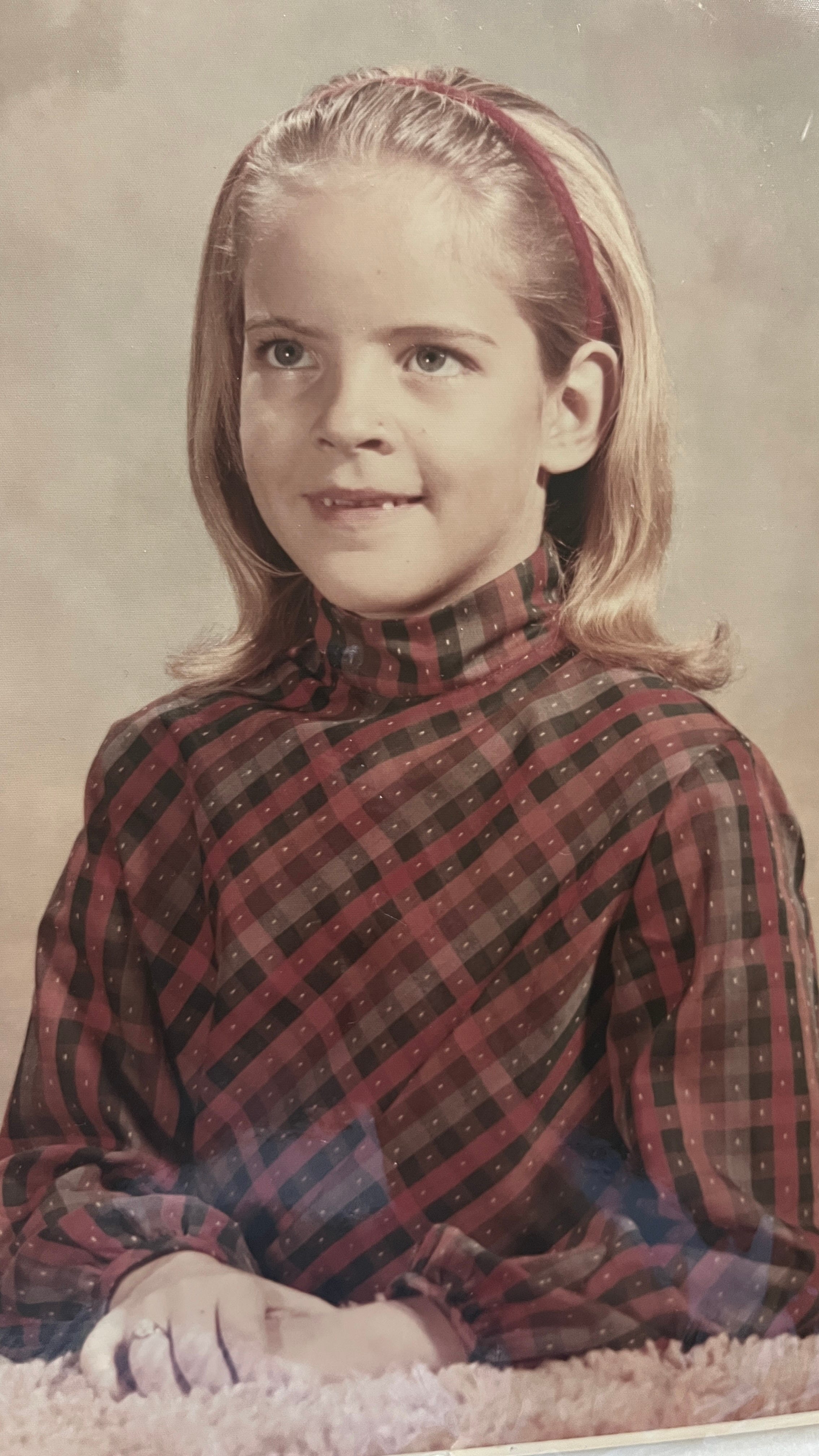
I have always been a good girl.
I knew being good was important before I was born — the way children know the things that keep them safe — not from being told, but from the air itself. The way a room changes temperature when the wrong thing is said. The way a father’s silence is louder than anything he could speak. The way a mother’s eyes go somewhere far away in the middle of an ordinary Tuesday, and a child learns, before she has words for learning, that the safest thing she can do is not need anything.
I was very good at not needing anything.
I grew up in a home where Jesus was Lord and fear was the landlord. Where grace was preached on Sunday and performance was the currency of every other day. My father was a Baptist preacher — a good man, a sincere man, a man trying to hold together a story that was quietly coming apart at the seams. My mother carried something heavy that no one named. In the closed world of our faith, there was no language for what lived inside her — only silence, shame dressed as concern, and the unspoken agreement that some stories are better left in the dark.
I had no words for any of this while I was still in the womb. But I arrived already fluent in its grammar. Be good. Don’t need anything. Fix what looks broken in other people’s stories, because broken things cause disconnection, and disconnection is dangerous.
If I played my role well enough, I believed, I might feel safe one day.
I played that role for fifty years.
I was in my forties when I discovered that I was not, in fact, a sinner white-knuckling my way toward God’s reluctant approval. I was a saint who sinned. I latched onto Galatians 2:20 with every ounce of my being. I am a daughter, not a defendant. I am a beloved child of a Father who is — and this is the part that still takes my breath — actually, genuinely, unconditionally for me.
Something came alive in my soul the day I learned these truths.
I wept. I laughed. I went back for more — more books, more podcasts, more theology, more confirmation that this beautiful, terrifying thing I had stumbled into was real and not heresy. I learned the language of grace the way you learn a second language as an adult — with great effort and great joy and the occasional relapse into the mother tongue of fear.
And still, something was off.
The light was real. The grace was real. But the room kept doing what the room had always done, and I kept trying to hold the candle steadier, higher, longer, wondering why the warmth never quite reached the walls.
Every story has a narrator.
Not the author — the narrator. The voice inside that is constantly interpreting what is happening to you, around you, and because of you. The voice that decides what problems are yours to solve and which solutions are available. The voice that looks at a closed door and says you weren’t good enough, or lucky enough, or enough — and you already knew that, didn’t you?
Most of us inherited our narrator the way we inherited our eye color. It arrived before we had any say in the matter. It is so intimate, so constant, so woven into the fabric of how we experience everything, that we rarely think to question it.
We question our beliefs. We question our habits. We question our parenting and marriages and theology. We go to therapy, read books, attend retreats, and return home with better information and the same narrator.
Which is why life can improve and still feel off.
The orphan narrator is not a villain. It is a survivor. It is the voice that forms in the absence of a safe Author and teaches us to do what closed systems do — generate everything from within itself. Identity. Setting. Problems. Solutions. All of it self-produced, self-managed, self-explained.
The orphan narrator is extraordinarily resourceful. It will help you achieve remarkable things. It will also, quietly and without malice, keep writing the same story, because it only knows how to write from inside the closed system it was born into.
New information does not change it. New identity does not change it. New theology, held in the hands of the same narrator, becomes one more thing to perform correctly.
There is a moment in the desert that many of us pass through too quickly.
Jesus has been fasting for forty days. He is hungry in a way that rewrites your thinking. And the enemy comes — not crudely, not obviously, but with something far more sophisticated than a frontal attack.
“If you are the Son of God, turn these stones to bread.”
Jesus does not argue about who he is. He does not defend himself. He does not reach for the obvious response to an identity challenge because he sees something the enemy hoped he would miss.
The question was never really about identity.
It was about whose story he was in.
Turn stones into bread — in a setting of scarcity, using the solutions scarcity offers, solving the problems scarcity defines. Jump from the temple — let the empire’s audience validate what the Father has already spoken. Take these kingdoms — receive dominion the way the empire grants it, through power and possession rather than through death and resurrection.
Every temptation was an invitation to be the right person in the wrong story.
And Jesus — hungry, tired, alone in the wilderness — stayed in his story. Not by defending his identity, but by knowing his Author. This is not the setting. These are not the problems. Those are not the solutions.
The whole story belonged to the Father. Not just his identity. All of it.
I did not know, for a long time, that there was a difference between the gift of a new identity and the gift of a whole new story.
I had found something true about myself — genuinely, achingly true — and I had carried it back into the only world I knew, the way you carry a candle into a dark room and feel, for a moment, like everything has changed.
The candle was real. The light was real.
But the story that played out in that room was still all up to me.
There is another narrator.
Not the voice that generates everything from within itself, but the voice that receives everything from a Source outside itself. Not the orphan who must win the story to survive it, but the child of God who witnesses the story being written and trusts the Author, even in chapters that make no sense yet.
This narrator does not interpret closed doors as personal failure. It asks what the Author might be doing. It does not see problems as evidence of unworthiness. It sees them as the next question in a story that is moving somewhere good. It does not reach for empire solutions — power, performance, spectacle, control — because it knows the kingdom operates on entirely different physics.
In a kingdom story, the setting is not the empire. The problems are not threats to be survived or gaps to be closed. The solutions are not self-generated. And the outcomes — this is the part that can take years to receive — are not yours to carry.
You were never meant to carry them.
You were meant to tend and nourish the life in front of you, stay connected to the Source, release what causes decay, and trust that flourishing happens — not because you measured it into existence, but because that is what life does when it is rooted in the right soil.
I am still learning. I put my feet on the floor some mornings and the orphan narrator is already talking before I take my first breath. There is a measure-up world waiting outside the door, and it is very loud, and it has known my name since before I was born.
But I have found something the orphan narrator cannot explain and cannot survive: a story I did not write, told by an Author who knew my name before the world did, in a kingdom where I am not a problem to be managed or a role to be performed.
I am a unique expression of kingdom design.
I am always becoming Janet — God is gracious, gift from God — not by performing, but through the slow and sometimes tender work of learning to let a different narrator tell the truth about who I am and whose story I am living in.
The problem was never you.
It was the story you were handed before you had words.
And there is a story still available — authored by the One who knit you together, who knew your name before your parents chose one, who is not managing your life from a distance but narrating it from the inside, with more grace and more imagination and more hope for your ending than you have yet allowed yourself to believe.
The narrator changes everything.
Not just the opening line.
The whole story.
What narrator have you been living under — and what would it mean to let the Author take back the pen?
If this resonated and you want to go deeper, join us at The Table — a free monthly gathering on the first Thursday of every month, 8-9 pm CT. Come human. Come hungry. Register here.
Janet Newberry writes about what becomes possible when families stop managing symptoms and start healing their story. Through John 15 Academy, formation cohorts, and the Love Is Fearless podcast, she helps parents and families live in the story they were made for — moving from pressure and performance toward lives rooted in connection, flourishing, and the restoring love of God.
Janet’s work integrates faith, neuroscience, attachment, and family formation, but it is not a substitute for licensed mental health care, therapy, or counseling. If you or someone in your family is experiencing acute mental health symptoms, abuse, trauma, or crisis, please seek support from a qualified mental health professional.
All content and services are for informational and formational purposes.
This is beautiful. Thank you for sharing such deep truths articulated in a way that invites further reflection. ✨
This is my favorite one yet. There is just so much here to unpack. The gift of a new identity ALONG with the gift of a whole new story. Which narrator am I listening to? Mostly myself, and when I am doing that, nothing is really changing, even if the truth is that everything has changed.